01
Model
Proposes decisions. It is a component, not the whole system.
Building, Controlling, and Scaling LLM Agents in Practice
Build the smallest possible agent. Run it. Break it deliberately. Then engineer the failure.
For leaders: Agentic Engineering for Executives, a free briefing: the questions to ask before you approve an agent (PDF).
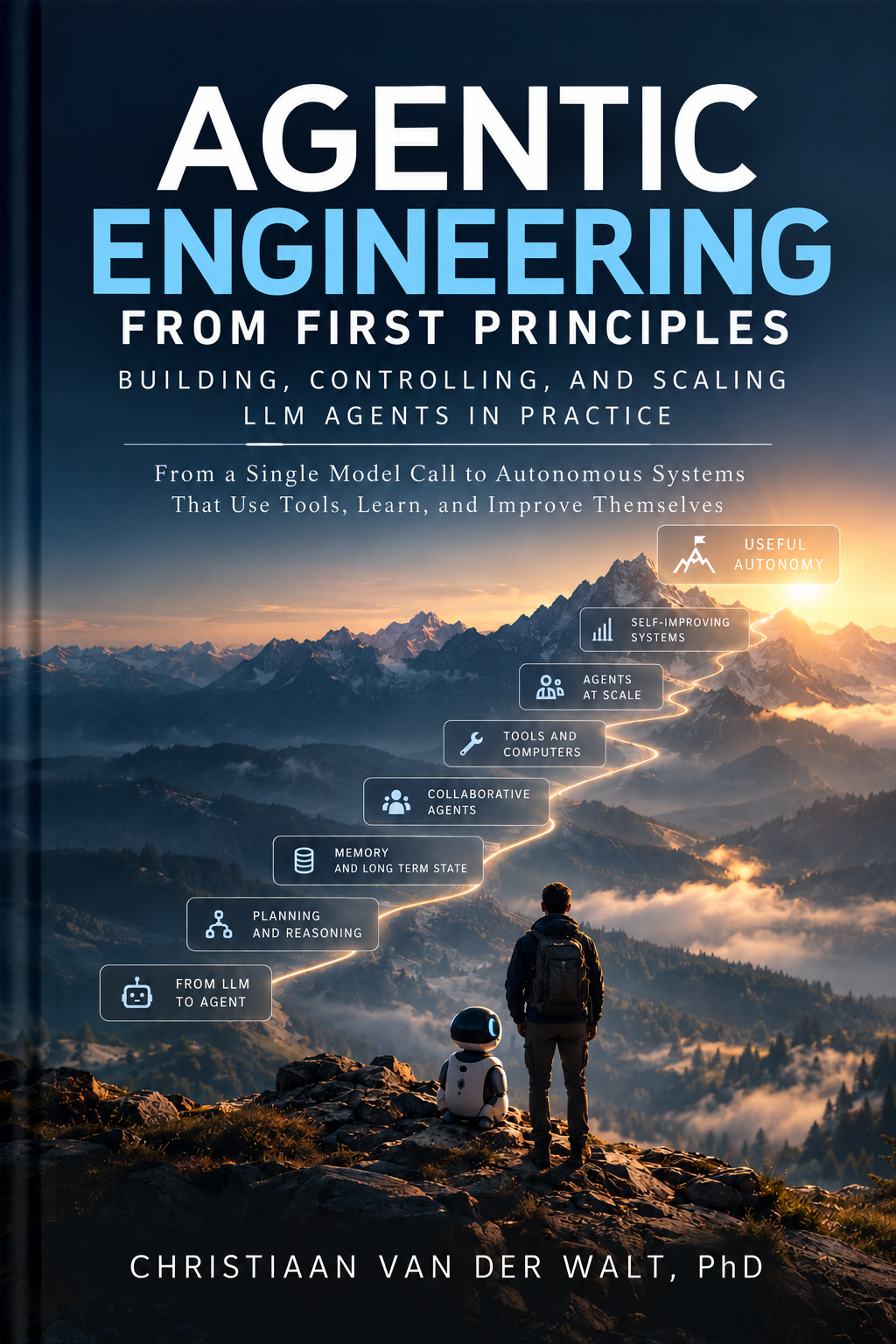
An agent is a software system in which a model participates in decisions that can affect an environment. Most of the field can be understood through five components.
Proposes decisions. It is a component, not the whole system.
The information selected and made visible for the current decision.
Capabilities whose consequences can change an external environment.
What persists: working state, memory, artifacts, checkpoints and experience.
What may happen, how execution proceeds, what resources are available, and when it stops.
The objective is not maximum autonomy. It is useful autonomy under appropriate control.
Start with one model call and progressively add abilities, reasoning, collaboration, reliability, and advanced autonomy. Browse every chapter: question, lecture, principle and experiments →
A narrated lecture for every chapter, built from the book's own slides. Pick a chapter to watch it here.
Every experiment isolates a mechanism, creates a failure, and turns the failure into an engineering lesson. Try them in the Lab: replay a recorded real run of any experiment and watch, step by step, what the model and the agent do. No programming or API key needed.
Every experiment calls a real model through a visible control loop, and all 59 also have runnable LangChain and LangGraph implementations.
Browse framework examples · Installation and run guide · Live-model experiments
class Agent:
    def run(self, goal):
        messages = [{"role": "user",
                     "content": goal}]

        for step in range(self.max_steps):
            decision = self.model.generate(messages)
            messages.append({"role": "assistant",
                             "content": decision})

            if decision.get("done"):
                return decision["answer"]

            observation = execute(decision,
                                  tools=self.tools)
            messages.append({"role": "tool",
                             "content": str(observation)})

        raise RuntimeError(
            "Step limit reached"
)Download the complete 602-page PDF: every experiment printed in full with its real output, a briefing for executives, more than 200 drawn figures, LangChain and LangGraph examples, recorded runs on real models, a glossary, a bibliography and an index, on the full journey from a model call to controlled autonomy.
Free, with no sign-up. You can also read Chapter 1 on its own, or the executive briefing, Agentic Engineering for Executives.
The complete book, 602 pages. No email needed.
Download the full PDFYour download has started. If it doesn't, try this link.

Christiaan van der Walt is an engineer, machine learning researcher, and technology leader with nearly two decades of experience developing AI systems from first principles and bringing them into production. He currently leads Advanced Analytics within Momentum Group’s Group Technology structure. His work spans generative AI, recommendation systems, predictive analytics, and patented digital fitness assessment technology.
His earlier career includes several years as a machine learning researcher at the Council for Scientific and Industrial Research (CSIR), where he developed algorithms and systems across speech processing, biometrics, security, and environmental modelling. He also completed a research internship at IBM’s T.J. Watson Research Center in New York, working on automatic speech recognition and speech-driven information retrieval.
Christiaan holds a PhD specialising in machine learning from North-West University and engineering degrees from the University of Pretoria. His research includes contributions to density estimation and pattern recognition, with publications at conferences including AAAI and ICASSP. His experience combines mathematical foundations, hands-on software development, research, and the practical demands of deploying AI in real organisations.
59 executable experiments. One tiny agent kernel. No magic.